Manuscripts under review · u.1
Beyond Constant Transparency: Evaluating a Pedestrian-Aware Transparency-Adaptive Interface for XR Walking
International Journal of Human-Computer Interactionrevised manuscript under review
Abstract
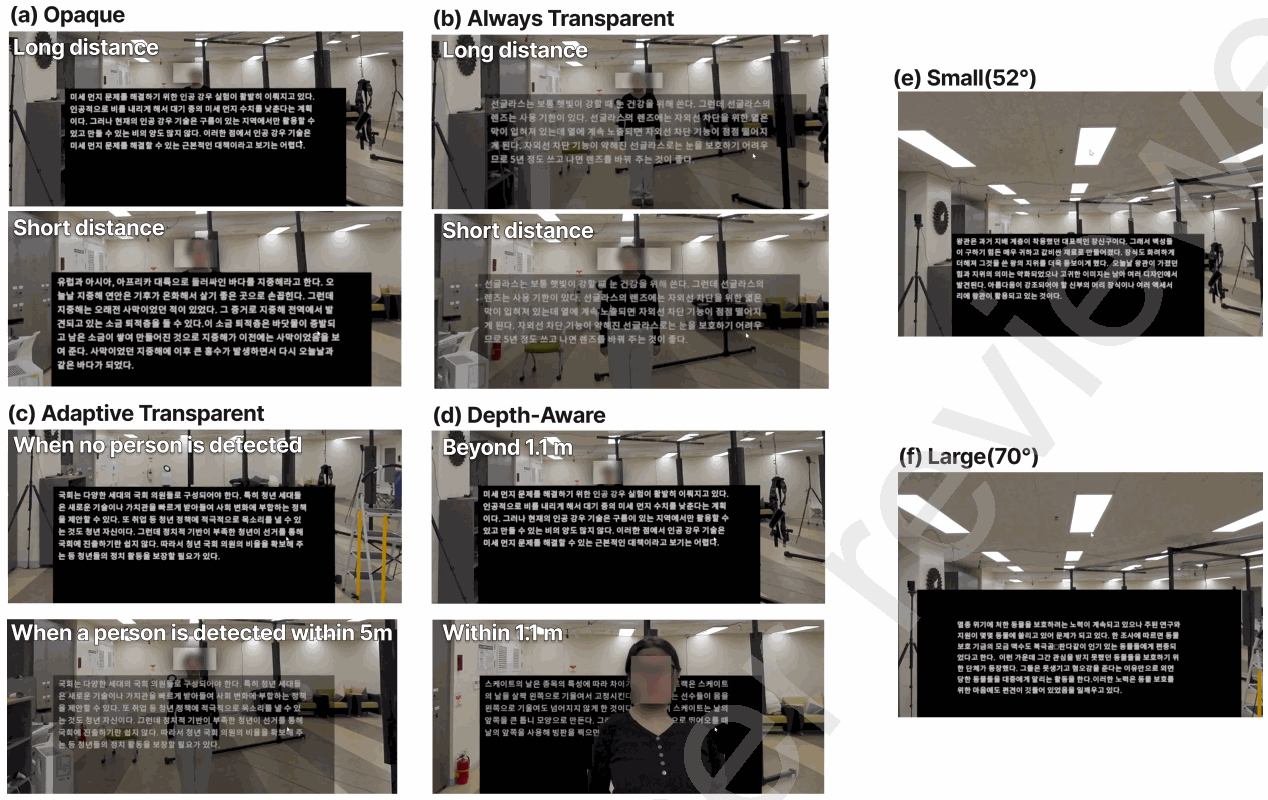
Mixed Reality (MR) head-mounted displays are emerging as platforms for everyday personal computing, yet their use during walking raises critical safety concerns due to visual occlusion of the physical environment. While transparency-based interfaces have been proposed to address this issue, systematic comparisons of different UI rendering methods in realistic pedestrian scenarios remain limited. This study investigated how four UI rendering methods - Opaque, Always Transparent, Adaptive Transparent, and Depth-Aware - combined with two UI sizes (small and large) affect walking safety and UI legibility during pedestrian encounters. Twenty participants performed a dual-task paradigm involving continuous reading while walking and avoiding unpredictable pedestrians. Results revealed that transparency-based methods (Always Transparent and Adaptive Transparent) significantly outperformed occlusion-based methods (Opaque and Depth-Aware) across safety metrics, walking performance, subjective workload, and user preference. Specifically, transparency-based conditions yielded longer minimum time to collision, greater passing clearance, faster walking speeds, and lower NASA-TLX scores. In contrast, Depth-Aware method performed comparably to the Opaque condition, suggesting that depth-based occlusion alone is insufficient for dynamic pedestrian avoidance. A significant interaction between UI size and rendering method further indicated that transparency mitigates the negative effects of larger interfaces on user experience, whereas occlusion-based interfaces require size minimization to preserve safety and user experience. While Always Transparent achieved the highest subjective ratings for perceived safety and visual clarity, Adaptive Transparent offered a more balanced experience by preserving text legibility when no pedestrians were detected. Overall, these findings provide actionable design guidelines for developing mobile MR interfaces that balance content visibility with safety.